What is the schedule for Chicago bridge lifts in 2026?
The full 2026 Chicago River bridge lift schedule, why the lifts happen twice a week in spring and fall, and how sailboat season shapes every river cruise route.
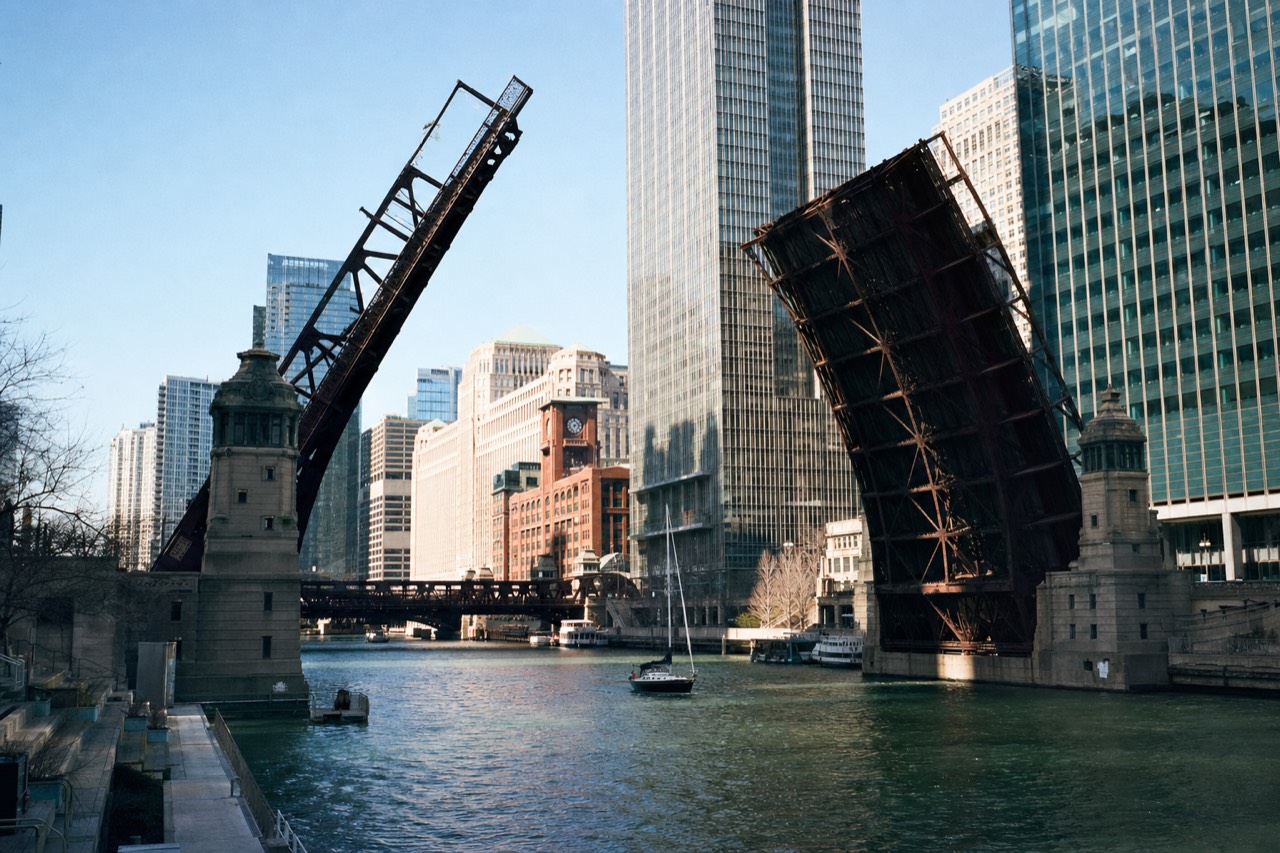
Twice a week, on a schedule the city publishes in advance, Chicago raises its bridges. It is one of the strangest, most quietly beautiful civic rituals in the country: 27 movable bascule bridges lifting in sequence along the Chicago River so that sailboats with tall masts can travel between the river and Lake Michigan. The spring 2026 lifts began April 22. If you have ever stood on the Michigan Avenue bridge and watched two leaves of steel counterweight rise like arms, you have watched a system that has been running, in one form or another, for decades. Here at Chicago River Cruises we spend our days on this stretch of water, and the lift schedule is the single most common timing question we hear from visitors planning a spring or fall trip.
What is the schedule for Chicago bridge lifts in 2026?
Chicago's Department of Transportation runs scheduled recreational bridge lifts on Wednesdays and Saturdays in spring and fall. Spring 2026 lifts began April 22, and the fall 2025 series ran from early October to mid-November, so expect the fall 2026 lifts to follow a similar early-October-to-mid-November pattern. Each lift takes roughly 8 to 12 minutes per bridge, and lifts happen in sequence along the river rather than all at once.
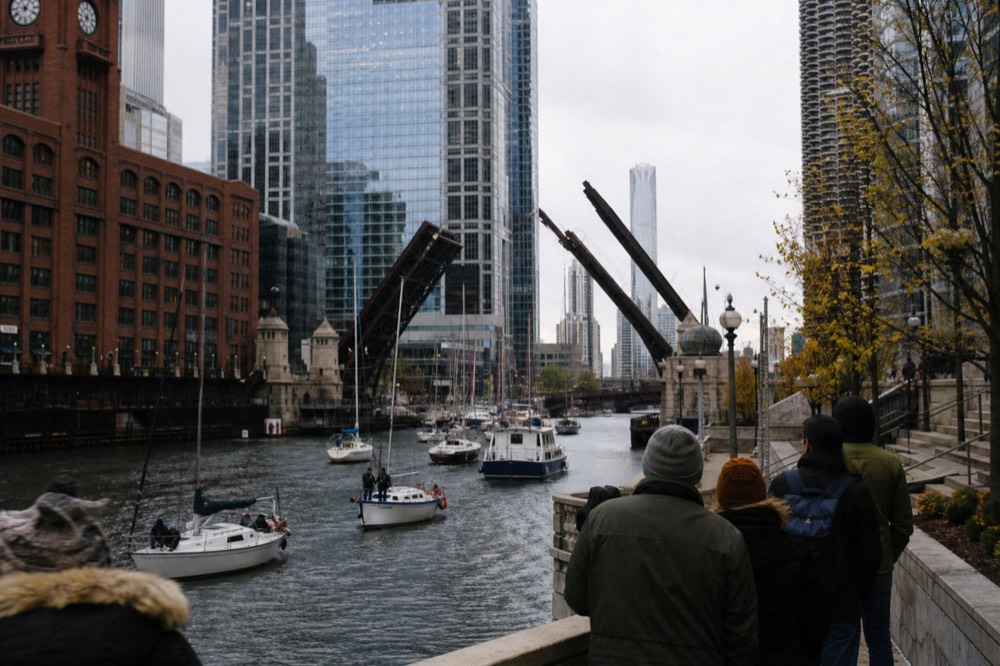
The mechanics are simple once you see them. A bridge lift series starts at one end of the river, often near the lakefront, and moves bridge by bridge. Each bridge's two leaves rise, the waiting sailboats pass through, and the leaves come back down before the next bridge upstream goes up. The whole procession can take a couple of hours from the first bridge to the last, which is why spectators pick a spot early and stay put. The route covers 27 movable bascule bridges between South Ashland Avenue and DuSable Lake Shore Drive.
The city posts the official dates each season, and the announcement itself is worth reading because it lists the streets, the start time, and the expected order. You can find the spring 2026 announcement on the city's own site: CDOT's spring 2026 bridge lift notice.
Why does Chicago raise its bridges twice a week?
Because the river is the only way for tall-masted sailboats stored upriver to reach Lake Michigan, and the bridges are too low for their masts. The city commits to scheduled lifts in spring, when boats head to their summer moorings on the lake, and in fall, when they head back to winter storage upriver. Twice weekly, Wednesdays and Saturdays, is the compromise that keeps boat traffic moving without closing downtown crossings every day.
This is a story about geography and stubbornness. Chicago's river branches run for miles through the city, and a large share of the recreational sailboat fleet spends the winter in yards and marinas up the North Branch and the South Branch. In spring, every one of those boats needs to get to the lake. In fall, every one needs to come back. Their masts are taller than the clearance under the bridges, so the bridges have to open, and a bascule bridge opening is not a small event: traffic stops, river traffic stops, and the leaves swing up on giant trunnions with counterweights hidden in the bridgehouses.
Rather than lift on demand, which would gridlock downtown, the city schedules the lifts. Boaters get a predictable window. Drivers get a predictable headache. Pedestrians get one of the best free shows in Chicago. The twice-weekly cadence in spring and fall is the balance point, and it has been refined over years of practice.
There is a second, less obvious reason the schedule matters. The Chicago Harbor Lock, which connects the river to Lake Michigan, closes each year from mid-November to mid-April. That closure limits the lake portion of any cruise route during that window, and it also defines the shoulders of the bridge lift season. The lifts happen when the lock is open and the boats are moving. When the lock closes, the sailboats are already where they need to be for winter.
Where is the best place to watch a bridge lift?
The most popular spots are along the Main Stem downtown, especially the Michigan Avenue and State Street bridges, because you get a raised bridge, the Wrigley Building and Tribune Tower in one frame, and sailboats passing underneath. The Riverwalk between Michigan and Wabash is the classic choice. Arrive early, because the bridges lift in sequence and the crowd builds as the procession moves upstream.
If you want a quieter view, head away from downtown. The bridges between Kinzie Street and the lakefront get the boats first, so the action there starts before the Michigan Avenue crowd shows up. Further west along the Main Stem and the South Branch, around Clark and LaSalle, you often get the same spectacle with a tenth of the crowd and a completely different skyline backdrop of older, heavier steel bridges.
A few practical notes. The lifts happen in daylight, and the fall series in particular puts the sun low over the western branches, so photographers do better facing east in the morning. Wind matters more than you would think: the leaves are enormous steel sails, and the operators wait for gusts to settle before swinging a bridge. Bring patience. Each bridge takes 8 to 12 minutes, and the boats queue between lifts, so a full procession is a slow, drifting parade rather than a single dramatic moment.
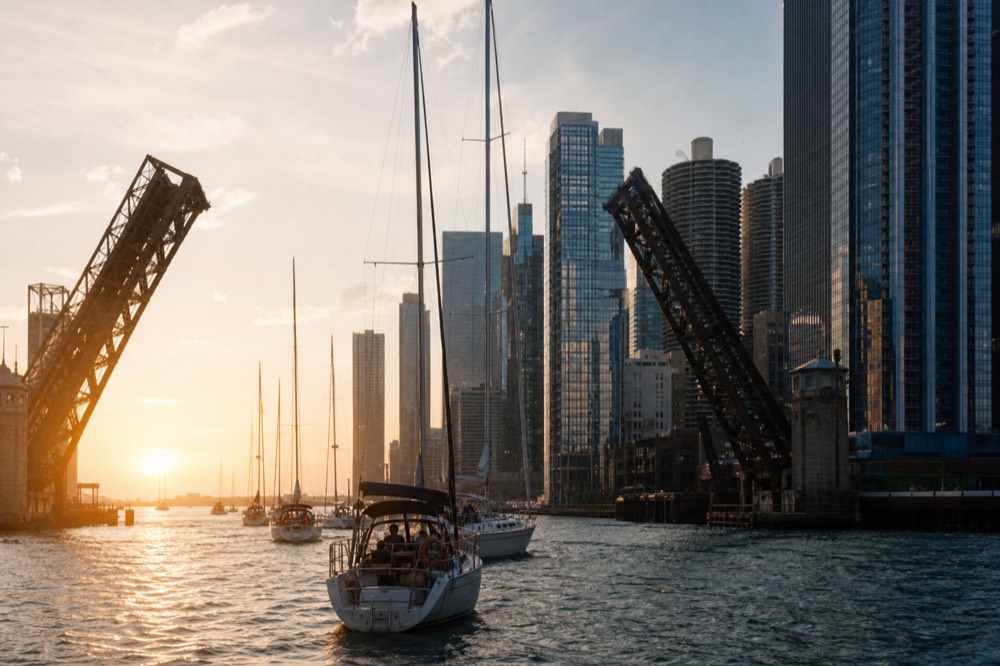
If watching from shore gives you the itch to be on the water yourself, that itch is easy to scratch. The same stretch of river the sailboats use is the stretch the architecture cruises run daily, and you can read our guide to Chicago river cruise tours for the full lineup.
The fact that any of this works at all, boats moving between the river and the lake, goes back to one of the great engineering feats in the city's history. In 1900, with the opening of the Chicago Sanitary and Ship Canal on January 2 of that year, the river's flow was reversed, diverting sewage and wastewater away from Lake Michigan, the city's drinking-water source, to address public health crises including typhoid and cholera. The Sanitary District of Chicago, established in 1889 to oversee the reversal, built a 28-mile canal connecting the river to the Des Plaines River so gravity carried the flow toward the Mississippi River basin instead of the lake. The reversal and the resulting lock system, including the Chicago River Controlling Works, maintain navigable depths and control flow between the river and the lake, which is exactly what makes today's tour boat routes possible.
Among the cruises themselves, one stands out for pedigree. The Chicago Architecture Center, formerly the Chicago Architecture Foundation, has run its docent-led river cruise since 1983, operated in partnership with Chicago's First Lady Cruises. Instead of standard crew commentary, the tours are narrated by CAC-trained volunteer docents, a format that distinguishes this cruise from most other Chicago boat tours. The route covers more than 50 buildings along the river and runs about 90 minutes, and the cruise has been named the #1 boat tour in the US by USA Today, has won Chicago Reader's Best Tour for more than 10 years running, and is TripAdvisor's top-rated Chicago boat tour. First Lady itself is a fourth-generation, family-owned operator founded in the 1930s by Portuguese immigrant Arthur Agra as speedboat rides at Navy Pier, and it became the official operating partner for the CAC architecture cruise in 1993.
That docent cruise runs about 1.5 hours aboard First Lady, and while no lift sighting is ever promised, a departure that happens to queue under a rising bascule bridge turns an already well-reviewed 90 minutes into something nobody else on the Riverwalk gets to see.
Shoreline's skip-the-ticket-line architecture cruise runs the same downtown stretch at a brisker pace, and it is the pick most visitors book first when they are choosing between the three.
Do bridge lifts affect river cruises?
Yes, but mostly indirectly. Cruise boats are low enough to pass under the bridges without lifts, so tour routes are not blocked by bridge clearance. The real effects are seasonal: the harbor lock closure from mid-November to mid-April limits lake portions of cruise routes, and the bridge lift season marks the start and end of the peak cruise window, with the Chicago Architecture Center season running March 15 through November 22 in 2026.
This is the part most visitors miss. The tour boats you see stacked along the Riverwalk, the Wendella boats, the Shoreline fleet, the First Lady vessels, none of them need a raised bridge. They fit underneath with room to spare. So a scheduled lift on a Wednesday does not stop the architecture cruise departing that afternoon. What the lifts do mark is the pulse of the whole boating year: when the sailboats move in spring, the season is on; when they move back in fall, it is winding down.
The lock closure is the bigger operational fact. From mid-November to mid-April, boats cannot pass between the river and the lake, so any cruise that normally includes a lake leg, like the combined lake-and-river architecture tours, runs a river-only route during that window. Wendella is the outlier: it operates year-round except Christmas Day, while most other operators run roughly mid-February or March through November or December, weather permitting.
There is also a spectator's angle worth considering: watching a lift from a cruise boat is a rare treat. If a scheduled lift happens to coincide with a departure, the tour boat queues with the sailboats and drifts while the bridge ahead goes up, and you get the view from underneath, looking straight up at the underside of a raised bascule leaf. It does not happen often, and no operator can promise it, but when it does, it is the best seat in the city.
How do the bridge lifts actually work?
Each bridge is a bascule bridge: two leaves, one on each side, pivoting upward on a shaft near one end, balanced by enormous counterweights housed in the bridgehouses you see along the river. To open, the leaves rotate up and back until they stand nearly vertical, forming the V shape every Chicago postcard knows. The whole motion per bridge takes 8 to 12 minutes, including traffic clearing and the boats passing through.
Chicago built bascule bridges because the river is narrow and the crossings are many. A swing bridge would need a full pivot circle in the middle of a crowded channel. A lift bridge would need high towers at every crossing. The bascule design, with its counterweight tucked into the picturesque bridgehouse, fit the city's constraints, and Chicago ended up with one of the greatest concentrations of movable bridges anywhere.
The operators work from the bridgehouses, some of which are tiny rooms perched above the leaves. The sequence is coordinated along the river so that boats move in a convoy: bridge one opens, boats pass, it closes, bridge two opens. That convoy logic is why the schedule matters so much to boaters. Miss the convoy and you may be stuck between bridges, mast too tall to go under, waiting for the next lift day.
| Season | Typical dates | Days | Route | What happens |
|---|---|---|---|---|
| Spring 2026 | Began April 22 | Wednesdays and Saturdays | 27 bascule bridges, South Ashland Ave to DuSable Lake Shore Drive | Sailboats move from upriver winter storage to Lake Michigan |
| Fall 2025 | Early October to mid-November | Wednesdays and Saturdays | Same 27 bridges | Sailboats return from the lake to winter storage |
| Lock closure | Mid-November to mid-April | N/A | Chicago Harbor Lock | No boat passage between river and lake; lake cruise legs limited |
When is the best time of year to see the lifts?
Fall is the better season for spectators. The fall series runs from early October to mid-November, the light is lower and warmer, the sailboats come downstream in big groups as owners pull their boats before the lock closes, and the river is still busy with cruise traffic. Spring lifts, which began April 22 in 2026, are more spread out and the weather is less reliable.
Fall also gives you a two-for-one. The architecture cruise season is still running, the trees along the Riverwalk turn, and the boats heading downstream are often dressed for the season. Pick a Saturday in late October, watch the morning lift from the Michigan Avenue bridge, then take an afternoon cruise while the operators are still running full schedules before the November wind-down. If your own boat idles for a lift along the way, that pause is a good moment to grab a drink or use the restroom, both covered in our look at what's actually available onboard.
Spring has its own charm if you like fewer people. The April lifts coincide with the very start of the cruise season, and the river is quieter. The tradeoff is unpredictability: a cold front can delay boat movements, and the procession is thinner because owners bring their boats out over several weeks rather than in a rush.
Can you see a bridge lift from a river cruise?
Sometimes, yes. Tour boats are low and pass under closed bridges, but when a scheduled lift coincides with a departure, the tour boat queues with the sailboat convoy and waits under the raised bridge. No operator schedules around the lifts or promises a lift sighting, so treat it as a bonus, not a feature. Your best odds are on a Wednesday or Saturday departure during the lift windows.
The boats most likely to be on the water during a lift are the big sightseeing fleets, because they run the most departures. Shoreline Sightseeing alone carries just over 1 million passengers a year on average, so its boats are out constantly in season, and the odds of one being in the right place at the right time on a lift day are decent. Wendella, running since 1935, and the Chicago's First Lady fleet, the official partner of the Chicago Architecture Center cruise, are out daily too.
If you want to plan for it, here is the honest approach. Book a Wednesday or Saturday departure during the lift season, pick a morning slot, and accept that you will probably get a normal, excellent architecture cruise. If a lift happens to be running, you get a scene almost nobody photographs from the water. Either way you win, which is not something you can say about many timing gambles in travel.
The three boats most likely to be in the middle of the action are the ones above: Shoreline's skip-the-ticket-line architecture cruise, Wendella's 75-minute guided architecture cruise with 7,960 reviews behind it, and the 45-minute architecture tour from the Magnificent Mile, which is flagged as likely to sell out. All three run the downtown stretch where the lift procession is thickest.
What happens to the river between seasons?
Between mid-November and mid-April the lock is closed, the sailboats are stored, and the river quiets down. Wendella keeps running year-round except Christmas Day, but most cruise operators pause or slim their schedules, and the lake legs of any route disappear until the lock reopens. The spring bridge lifts, starting April 22 in 2026, are the visible signal that the full season is coming back.
Winter on the river is its own thing. The water is cold and dark, the tour fleets are mostly hauled out or moored, and the bridges stay down for months. Then, somewhere in late March, the lock reopens, the Architecture Center season starts on March 15, and the first cruise boats reappear on the Main Stem. The April lift days are the punctuation mark: masts moving downstream in convoy, bridges going up for the first time since fall, and the whole machinery of a Chicago summer clicking back into place.
If you are planning around the shoulders of the season, our guide to cruise boarding locations tells you which docks are closest to the best lift-watching spots, since the Wendella dock at the base of the Wrigley Building and the First Lady dock at 112 E. Wacker are both steps from the main action.
Common questions about Chicago bridge lifts
Chicago runs its recreational bridge lifts on Wednesdays and Saturdays in spring and fall, with spring 2026 lifts starting April 22 and the fall series expected to run from early October to mid-November. Each of the 27 bascule bridges takes 8 to 12 minutes to lift, and the lifts do not block river cruises, which pass under the closed bridges. The details below cover the most common questions boaters and visitors ask.
What is the schedule for Chicago bridge lifts in 2026?
Spring 2026 lifts began April 22, running on Wednesdays and Saturdays. The fall 2025 series ran from early October to mid-November, so the fall 2026 lifts are expected to follow the same early-October-to-mid-November pattern. Each lift takes about 8 to 12 minutes per bridge across 27 bascule bridges.
What days do Chicago lift its bridges?
Wednesdays and Saturdays during the spring and fall recreational lift seasons. The lifts run in sequence along the river, so the exact time any single bridge rises depends on its position in the procession.
How long does a Chicago bridge lift take?
About 8 to 12 minutes per bridge, including clearing traffic, raising the leaves, letting the waiting sailboats pass, and lowering the leaves again. The full procession across 27 bridges takes considerably longer as it moves bridge by bridge.
Do bridge lifts stop river cruises?
No. Cruise boats are low enough to pass under the closed bridges, so scheduled lifts do not block tour routes. The bigger seasonal factor is the Chicago Harbor Lock closure from mid-November to mid-April, which limits the lake portions of cruise routes.
Where should I watch a Chicago bridge lift?
The Michigan Avenue and State Street bridges are the classic spots, with the Wrigley Building and Tribune Tower in the background. The Riverwalk between Michigan and Wabash is the most comfortable place to wait. Arrive early, because the procession moves slowly and crowds build as it goes.
Why are the lifts only in spring and fall?
Because that is when sailboats move between their upriver winter storage and their summer moorings on Lake Michigan. The scheduled twice-weekly lifts give boaters a predictable window while keeping downtown bridge closures to a minimum the rest of the year.
The bridge lifts are the river telling you its own calendar. Learn to read it, and you will know when the sailboats arrive, when the cruise fleets are at full strength, and when the whole city leans back over the water for one last parade before winter.