Can I take a Chicago Architecture boat tour in a wheelchair?
A practical guide to taking a Chicago architecture river cruise in a wheelchair: docks, boarding, what to confirm with operators, and which cruise formats fit different mobility needs.
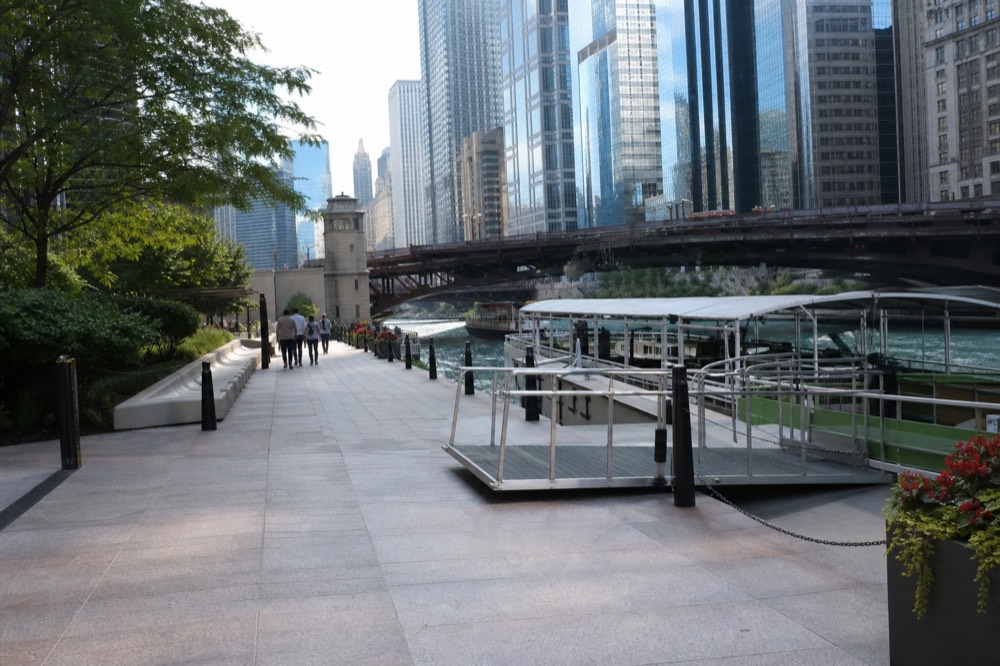
The Chicago River runs straight through the middle of downtown, and the architecture cruises that work its main stem and branches pass more than 50 named buildings on the better tours. The catch for a wheelchair user is that the experience starts at a dock, and docks are where most accessibility questions are actually decided. The river is level with the streets around it, which helps a great deal, but each operator boards from its own spot and each boat has its own deck layout.
This guide walks through what is known about the docks, what you should confirm with an operator before booking, and how to plan around the parts of the trip that are hardest to control from a chair. Where a specific accessibility detail is not published, I say so plainly rather than guessing, because wheelchair access is one area where a wrong assumption can cost you the whole trip.
Can I take a Chicago Architecture boat tour in a wheelchair?
In most cases yes, with planning: Chicago's main architecture cruise operators board from Riverwalk-level docks that sit close to street grade, and several run vessels with boarding arrangements that can accommodate wheelchairs, but each operator sets its own access policy, boat assignments change day to day, so you should confirm your specific date and boat with the operator before you book rather than relying on general claims.
That answer is deliberately cautious. The reason is simple: the Chicago river cruise fleet is not uniform. Shoreline Sightseeing, Wendella Tours & Cruises, and Chicago's First Lady Cruises (the operating partner for the Chicago Architecture Center cruise) each run more than one type of vessel, and a policy that holds for one boat may not hold for another. The Chicago Architecture Center's cruise is narrated by CAC-trained volunteer docents and covers more than 50 buildings over about 90 minutes, and it boards at 112 E. Wacker Drive on the Riverwalk. Wendella, founded in 1935, boards at 400 N. Michigan Avenue at the base of the Wrigley Building. Shoreline Sightseeing, founded in 1939 and now carrying just over 1 million passengers a year, boards from Michigan Avenue near the Apple Store and from Navy Pier.
None of those docks requires climbing a bridge staircase or descending a long ramp from street level, which is the single biggest structural advantage the river has over, say, a lake cruise from a raised pier. The Riverwalk sits only a few feet below Michigan Avenue and Wacker Drive at these points, connected by ramps and elevators at the bridgehouses. That makes the approach realistic in a wheelchair. What happens at the gangway is the part that varies.
The other variable is the boat itself. Architecture cruises run on vessels ranging from large open-deck sightseeing boats to smaller enclosed yachts, and deck layout, restroom configuration, and seating all differ. Operators generally want to help, and most will, but they need to know you are coming. Calling or messaging ahead, or checking the accessibility notes on the operator's live listing, is the step that turns a maybe into a yes.
If you want to compare the most-booked options side by side, these are the three architecture cruises travelers book most often from this site.
Which Chicago river cruise docks are easiest to reach in a wheelchair?
The four main boarding points are the CAC/First Lady dock at 112 E. Wacker Drive, the Wendella dock at 400 N. Michigan Avenue at the base of the Wrigley Building, the Shoreline Sightseeing docks at Michigan Avenue near the Apple Store and at Navy Pier, and the Odyssey Chicago River dock at 455 N. Cityfront Plaza Drive, and all four sit at or near Riverwalk or pier level rather than at the top of a flight of stairs.
The dock you choose shapes the first and last ten minutes of your trip, which for a wheelchair user are often the most stressful ten minutes. Here is what is documented about each one.
| Operator | Boarding point | Location details | Approach notes |
|---|---|---|---|
| Chicago Architecture Center / First Lady | 112 E. Wacker Drive | Southeast corner of the Michigan Avenue (DuSable) Bridge on the Riverwalk, near Tribune Tower and the Wrigley Building | Riverwalk level, reached from Wacker Drive via ramps and bridgehouse elevators |
| Wendella Tours & Cruises | 400 N. Michigan Avenue | On the Riverwalk at the base of the Wrigley Building, northwest corner of the DuSable Bridge | Riverwalk level, same ramp and elevator network as the east side of the bridge |
| Shoreline Sightseeing | Michigan Avenue near the Apple Store, plus Navy Pier | Riverwalk dock downtown, plus dock at Navy Pier | Navy Pier is a pier-level boardwalk with elevator access through the pier complex |
| Odyssey Chicago River | 455 N. Cityfront Plaza Drive | River Esplanade near NBC Tower | Esplanade level, east of Michigan Avenue along the north bank |
Two things follow from this table. First, the two most popular architecture cruise docks, the CAC/First Lady dock and the Wendella dock, sit on opposite corners of the same bridge, so if one operator's boat configuration does not work for you on a given day, the other is a short roll away. Second, Navy Pier gives Shoreline a genuinely flat, wide boarding environment, which is worth weighing if your chair is wide or you travel with a companion who also uses a mobility device.
The Riverwalk itself is a well-built accessible corridor: it runs below street level along the river with ramps and elevators connecting it to the upper streets at the bridges. Distance is the thing to plan for. Rolling from one end of the Riverwalk to the docks near Michigan Avenue can take a while, so if you are arriving by car or paratransit, aim to be dropped as close to the specific dock address as possible rather than planning to traverse the whole walk.
For photos, dock-level views are excellent from a chair because the seating decks sit above you, but the rail line is usually at standing height for ambulatory passengers. Ask the crew where the best sightline is from your spot before departure; most crews will make room if you ask early.
What should you confirm with the operator before booking?
Confirm five things in writing before you pay: whether your specific date's boat can board a wheelchair user, whether the chair goes on the boat with you or is stored dockside, whether the vessel has an accessible restroom, whether there is step-free transfer from gangway to deck, and whether companions can sit with you, because none of these is guaranteed by the general category of "architecture cruise."
Operators publish accessibility information unevenly. Some state policies clearly; others handle it case by case depending on which vessel is assigned to your departure. Treat the pre-booking contact as part of the booking itself, not an optional extra. A short list of questions covers nearly everything:
- Is the boat assigned to my departure able to board a wheelchair user, and if not, which nearby departure can?
- Can my wheelchair or scooter come aboard, and are there size or weight limits?
- Is there an accessible restroom on this specific vessel?
- Is the transfer from dock to deck step-free, or is there a step or lip at the gangway?
- Where should I arrive, and how early, so the crew can assist with boarding?
- Is there a designated spot where I can remain in my chair during the cruise?
Ask the same questions whether you book direct or through a listing platform. The operator, not the platform, controls the boat. If you book through a reseller and the listing's accessibility notes are vague, call the operator directly with your booking reference in hand.
One more practical point: the booking you want is the one where the answer is specific. "We are wheelchair accessible" is a weaker answer than "the departure on the vessel with the boarding ramp can take one wheelchair user, arrive early." If you get the first kind of answer, keep asking until you get the second.
If you are still choosing among the major options, the skip-the-ticket-line architecture cruise run by Shoreline Sightseeing is a frequent pick on this site, and its dock near the Apple Store is one of the more straightforward approaches to plan around.
How does boarding actually work on a river cruise boat?
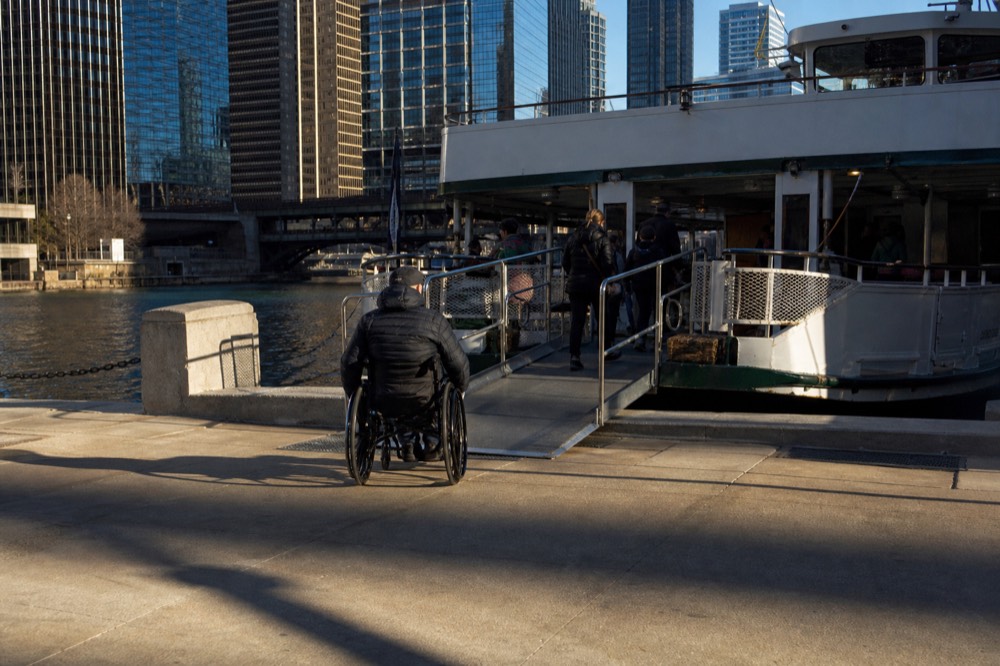
Boarding typically means crossing a gangway or ramp from dock level onto the main deck, then finding a spot on an open upper or lower deck, and the gangway is the single point where physical assistance, timing, and boat design converge, so it is the part to discuss with the crew in advance rather than improvising on arrival.
River cruise boats in Chicago are built for volume sightseeing. Shoreline Sightseeing alone carries just over 1 million passengers a year, which means crews board and disembark large groups quickly, usually in a matter of minutes. That pace is efficient for the fleet but can be unfriendly to anyone who needs a slower transfer, which is exactly why arriving early and identifying yourself to the dock crew matters. Boarding before the crowd, or after it, gives the crew room to work.
The physical transition differs by vessel type. Larger sightseeing boats usually board near dock level onto a lower deck, with stairs to an open top deck. Smaller vessels, like the historic yacht used for small-boat architecture tours, sit lower in the water and can involve a steeper or narrower crossing. Neither is automatically impossible, but neither is automatically easy either, and the difference is not something a listing category tells you.
Restrooms deserve a specific word. Not every vessel in the fleet has one, and among those that do, configurations vary. If a restroom matters for your comfort on a 45 to 90 minute cruise, and it usually does, get a direct answer about your specific boat. The same goes for shade and cover: open-deck boats expose you to sun and rain, and enclosed boats can be a better fit if temperature regulation is a concern.
Companion seating is usually easy, since these are unreserved or lightly reserved decks rather than airline-style seating. The exception is peak departures on peak weekends in July, when every rail spot fills. If you need your companion next to you and need a specific sightline, book a shoulder-season or early departure, and think through how light and crowds change across the day when you pick your time slot.
Once you have your answers from the operator and a departure that fits, locking it in early is the next step, especially for the most in-demand boats.
Which cruise format is easiest to plan around for accessibility?
The mainstream large-boat architecture cruises, Shoreline's architecture tour, Wendella's 75 to 90 minute architecture cruise, and the CAC docent-led cruise aboard First Lady, are generally the formats most likely to have boarding arrangements that work for a wheelchair user, while smaller vessels, speedboats, and dinner cruises each add variables that need case-by-case confirmation.
Here is how the main formats compare from a planning standpoint.
| Cruise format | Typical duration | Accessibility planning angle |
|---|---|---|
| Large-boat architecture cruise (Shoreline, Wendella) | 45 to 90 minutes | High passenger volume means established boarding routines; confirm gangway transfer and restroom on your vessel |
| CAC docent-led cruise aboard First Lady | About 90 minutes | Docent narration format, boards at 112 E. Wacker; season runs March 15 to November 22 in 2026 |
| Small-boat or yacht architecture tour | Varies | Smaller vessel, lower freeboard; ask specifically about gangway slope and deck space |
| Speedboat architecture cruise | 75 minutes | Operator notes it is not suitable for pregnant women or people with back problems; a jolting ride, confirm suitability directly |
| Lake-and-river cruise | About 1.5 hours | Adds the Chicago Harbor Lock transit; lock closes mid-November to mid-April, so winter bookings are river-only |
The speedboat category deserves a blunt note. The Seadog-style speedboat architecture cruise is marketed as a thrill ride, and the operator's own listing states it is not suitable for certain riders. A wheelchair user should not assume that a format built around high-speed maneuvers has any boarding arrangement in place. If speed is not the point for you, the large-boat formats cover the same buildings with far fewer unknowns.
The lake-and-river format has a seasonal wrinkle worth knowing. These cruises pass through the Chicago Harbor Lock to reach the lake, and the lock closes each year from mid-November to mid-April. In that window the lake portion drops off the route entirely. If you booked a lake-and-river cruise for the skyline-from-the-water view and travel in winter, you get a river-only cruise, so check what your date actually includes.
The CAC cruise has a different kind of planning angle: it is consistently ranked the #1 boat tour in the US by USA Today and is TripAdvisor's top-rated Chicago boat tour, which makes its departures the most in demand. Popular departures sell out, and a sold-out cruise cannot be re-arranged for your needs, so booking early is worth treating as an accessibility strategy, not just a pricing one. Footwear matters just as much on the day itself, since gangways and docks can be uneven; our guide to what to wear on a Chicago river cruise covers grippy shoes and other practical choices.
Travelers who want the boat and the Chicago Architecture Center's exhibits in the same visit can also look at the First Lady river cruise and Architecture Center combo ticket, which pairs the same roughly 90-minute cruise with museum entry, worth asking about if indoor accessibility matters as much as the boat itself.
Do season and weather change the accessibility picture?
Yes: winter shrinks your operator choices dramatically, since Wendella runs year-round except Christmas Day while most other operators run roughly mid-February or March through November or December, and the Harbor Lock closure from mid-November to mid-April removes lake portions of routes, so the accessible options in deep winter are far fewer than in summer.
Season affects wheelchair planning in a second, less obvious way: dock surfaces and gangways. Chicago winters bring ice and snow, and operations on the river are weather- and ice-dependent for every operator. A gangway that is a routine crossing in July can be a hazard in a January freeze, and crews adjust or cancel accordingly. If you are traveling between November and March, call the operator about conditions on your specific date rather than assuming summer norms.
Rain is a different question, and a common one. Departures generally run in rain, and open-deck boats mean you get wet. For a wheelchair user, wet decks and wet wheels are a real slip consideration, not a cosmetic one. The short version for accessibility purposes is that enclosed or partially enclosed vessels are the better rain plan, and confirming which vessel type your departure uses is worth one extra question when you book.
Bridge lifts are a genuine wild card. Twice a week in spring and fall, on Wednesdays and Saturdays, the city raises 27 movable bridges along the river so sailboats can move between dock and lake, and each lift takes about 8 to 12 minutes. If a lift coincides with your boarding window near the Michigan Avenue bridge, dock traffic, crowds, and vehicle access near the docks can back up briefly. It is not a reason to avoid those days, but it is a reason to build an extra cushion into your arrival time on lift days in April, May, September, and October.
One last seasonal note on the approach itself. The Riverwalk is a public space maintained to accessible standards, but winter maintenance of ramps and elevator access to the lower walk is worth a quick check during cold-weather trips, since the docks at 112 E. Wacker and 400 N. Michigan both depend on that vertical connection from street level.
How should you build the day around an accessible cruise?
Plan the dock approach, the boarding window, and the post-cruise exit as three separate steps: get dropped as close to your dock address as possible, arrive early so the crew can board you ahead of the crowd, and confirm your exit plan with the same crew before the boat leaves, because disembarking at a crowded dock at the end of a cruise is harder than boarding was.
The exit is the detail almost everyone forgets. When a boat returns, hundreds of passengers push toward the gangway at once, and the dock fills with the next departure's line. A wheelchair user who boards first and disembarks last, with the crew holding the flow for a minute, has a far calmer experience than one who tries to move with the crowd. Tell the crew at boarding that you will need an assisted exit, and they will usually stage it without your asking again.
Build the rest of the day around the dock geography. The CAC/First Lady dock and the Wendella dock sit at opposite corners of the DuSable (Michigan Avenue) Bridge, within a couple of minutes of each other, near Tribune Tower and the Wrigley Building. Navy Pier, Shoreline's second boarding point, is a longer trek from downtown but a flat pier environment with its own amenities. If you want to compare every dock in one place, our guide to Chicago river cruise boarding locations maps them all.
Restroom timing is part of the day plan too. If your vessel's restroom situation is uncertain or unworkable, plan a pre-boarding stop at a Riverwalk establishment near your dock and treat the cruise as a restroom-free 45 to 90 minutes. That is a normal way to handle it and nothing to be shy about with the crew.
Finally, keep your expectations generous rather than minimal. These cruises deliver one of the best architecture narratives in the country, from a vantage point that is genuinely hard to get anywhere else, and a chair changes the logistics, not the payoff. The buildings are the same, the docent or guide commentary is the same, and the river runs at the same level for everyone on board.
For a final side-by-side look at the three cruises most often booked from this site, here they are again with current listing details.
Common questions about wheelchair access on Chicago river cruises
Yes, wheelchair access on Chicago river cruises is possible with some planning: docks at Riverwalk level are the easiest approaches, restroom accessibility varies by vessel, wheelchairs sometimes come aboard depending on the operator, rain rarely cancels departures, and winter shrinks the pool of available operators without eliminating cruising entirely.
Can I take a Chicago Architecture boat tour in a wheelchair?
In most cases yes, with planning. The main operators board from Riverwalk-level docks near street grade, and several vessels can accommodate wheelchairs, but boat assignments and policies vary by operator and date, so confirm your specific departure with the operator before booking.
Which Chicago river cruise dock is best for wheelchair users?
There is no single official answer, but the docks at 112 E. Wacker Drive (CAC/First Lady), 400 N. Michigan Avenue (Wendella), and Michigan Avenue near the Apple Store (Shoreline) all sit at Riverwalk level connected to the streets by ramps and elevators, and Navy Pier offers a flat pier-level boarding environment.
Do Chicago river cruise boats have accessible restrooms?
It depends on the vessel, not the operator or tour category. Some boats in the fleet have restrooms and some do not, and configurations differ, so ask about your specific boat before you book rather than assuming.
Can my wheelchair come on the boat with me?
Sometimes. Whether a wheelchair or scooter can come aboard, and any size or weight limits, are set by the operator and the vessel assigned to your departure, so this is one of the core questions to confirm in writing before you pay.
Are Chicago river cruises cancelled in the rain?
Generally no, departures run in rain, and open-deck boats mean passengers get wet. For a wheelchair user, wet decks are a slip consideration, so an enclosed or partially enclosed vessel is the better rain plan if one is available for your time slot.
Do Chicago river cruises run in winter?
Wendella operates year-round except Christmas Day; most other operators run roughly mid-February or March through November or December, weather permitting. The CAC/First Lady season runs March 15 through November 22 in 2026, and the Harbor Lock closure from mid-November to mid-April removes lake portions of routes.
If you are weighing whether the whole outing is worth the logistics, our honest take in is a Chicago river cruise worth it covers that question directly, and Chicago River Cruises has a full lineup guide if you want to see every format at once.